
Case study · Redesign · Webflow · SEO
Hustle Singapore & Malaysia
Hustle, a Singapore school for creative and AI skills, had outgrown its WordPress site: it looked dated and was slow on phones. My team gave it a new look and I built the site in Webflow. We have worked together ever since. After the Singapore site we rebuilt the Malaysian one, and now we are growing both in search.
The client
Hustle teaches creative professions and confident work with AI: video editing, design, generative tools. Its learners are individuals and company teams, and part of the course fee can be covered by Singapore's SkillsFuture programme. Hustle works in Singapore and Malaysia, and each market has its own site.
The brief
The old WordPress site no longer matched the school. It looked dated and opened slowly, most of all on phones.
Hustle came with a clear brief: a completely new design and a build in Webflow. They wanted the design to have a wow effect, because the site of a creative school should surprise from the first screen. It also had to be fast and easy to use on a phone, and to lead visitors toward a course enquiry. And it had to grow with the school, with a CMS for courses, trainers and the blog and room for what comes next.
What we did
My team created a design to match the school: dynamic and playful, with bright brand gradients. I brought it into Webflow. The site came together page by page while the old one kept running, and in May 2026, three months after kickoff, it took the old site's place.
A CMS the team runs on its own
The content is set up so the school does not need a developer. Courses, trainers, articles, case studies and job openings each have their own collection and template. A new course is a single entry: its page, its card in the catalogue and its place in the filters build themselves from it. Even the announcement bar above the menu is switched on and rewritten by the team, without me.
Dates and prices you can trust
The schedule on the site is always current: upcoming intakes come straight from Hustle's own course management system. Visitors browse by month and choose weekday or weekend classes, and the team no longer copies dates by hand.
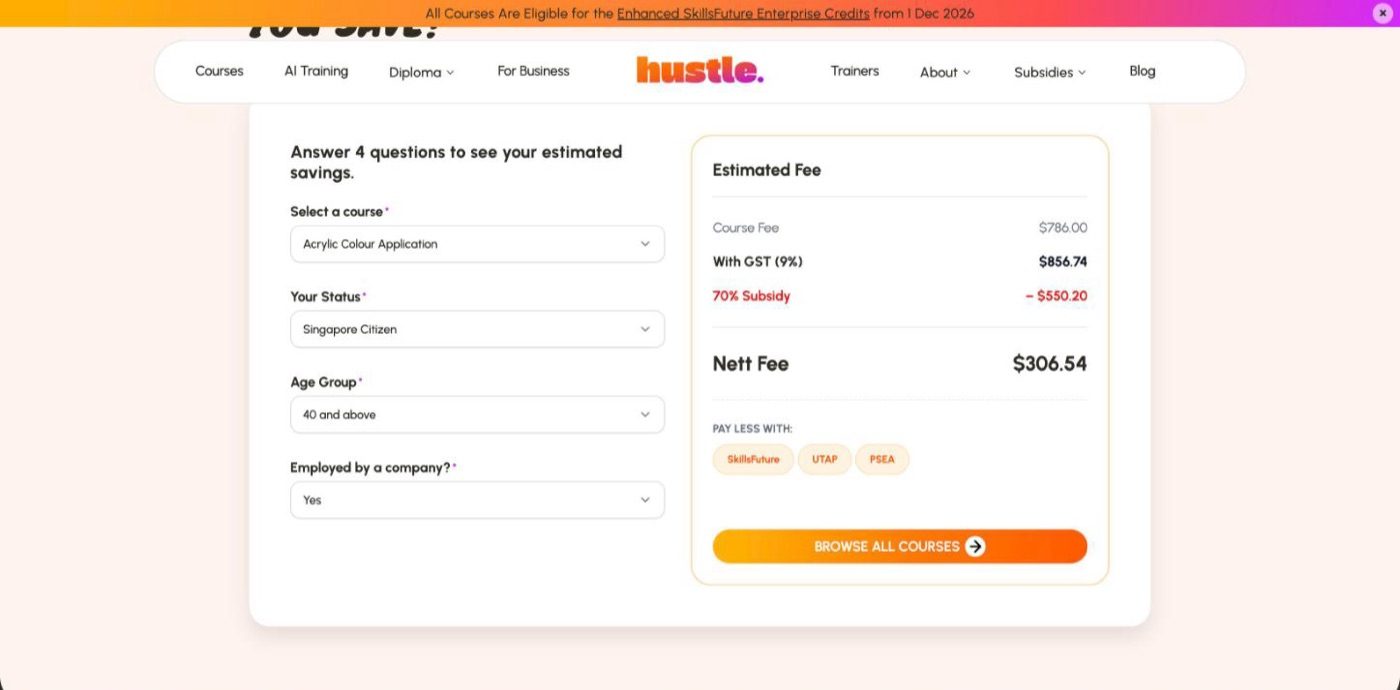
The main question before enrolling is simple: how much will I pay after the subsidy? The calculator answers it. A few choices, and the estimated final price is on the screen. The course fee lives in the CMS, so the price changes in one place and the calculator picks it up.
The blog moved, links and all
To avoid moving articles by hand, we wrote a dedicated scraper script. It pulled the blog from the old site and recreated it in Webflow exactly: text, images, links inside the articles and SEO fields. The article URLs stayed the same through the move.
For the other pages we prepared redirects from the old addresses in advance, and after the switch another script checked them on the live site.
Smooth motion across the whole site
Motion runs through the whole site and gives it its character. Pages unfold smoothly, at the pace of the scroll: each screen appears when the visitor reaches it. The interactive pieces turn reading into play. Shapes obey physics, and the diagram of AI tools can be rearranged by hand.
It is all built with GSAP, Matter.js and Swiper. The rest is hand-written JavaScript and SVG, which keeps heavy libraries off the page.
A second site in a week
After the Singapore launch Hustle came back with a new task: the school's Malaysian site was still on old WordPress. The two sites share a design, so the second did not have to be built from zero. We took the Singapore site as the base and moved the Malaysian content onto it. A week after kickoff, in October 2026, the client switched the domain.
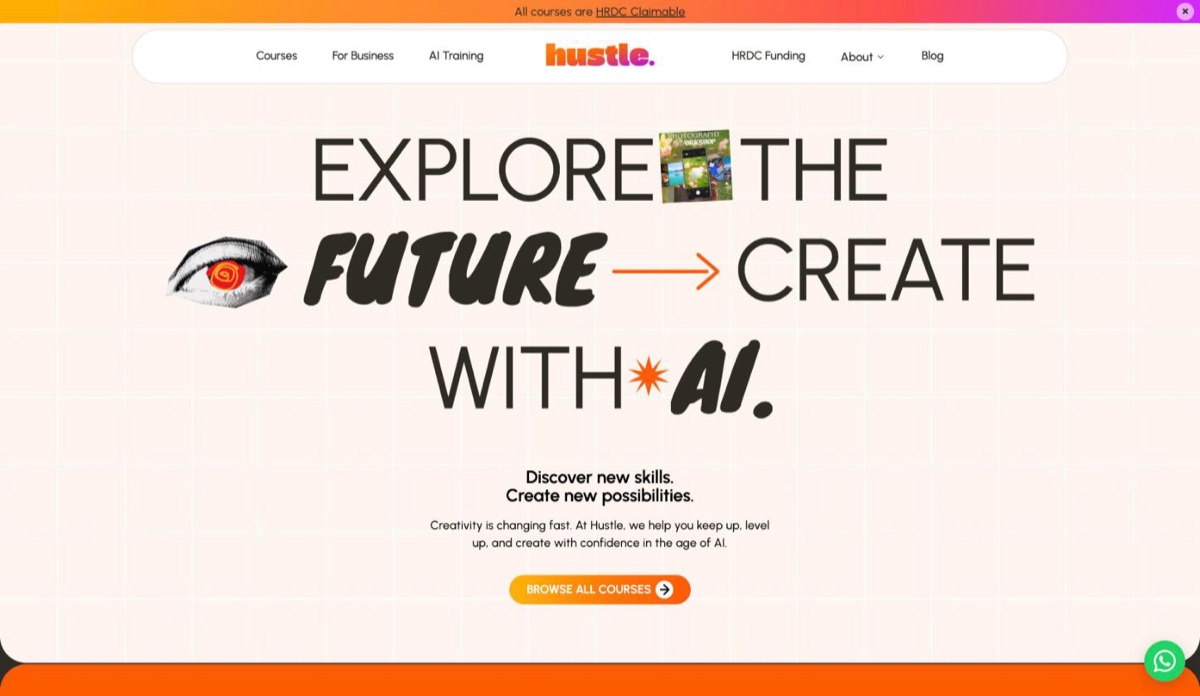
The Malaysian site is fitted to its market: prices in ringgit, HRD Corp course codes, and a block on claiming training through HRD Corp where Singapore has its calculator. Its HRDC course pages also show live intake dates.
By launch the old WordPress addresses had redirects, and matching pages of the two countries were linked for search engines.
Found in Google and in AI answers
After launch the next stage began: search. My team and I studied how Hustle shows up in Google and in the answers of AI assistants, and built a keyword map where each group of searches has its own page. Answers to frequent questions are marked up for search engines, and an llms.txt file shows AI crawlers the main pages of the site.
The result shows in Search Console: between early September and early November 2026, non-brand searches started bringing more clicks and impressions, and the site appears more often in Google's AI features.
Now and next
Work with Hustle began in February 2026 and continues today. Both sites keep changing: new pages appear and edits go in.
Next comes more search work on both sites. The Malaysian one launched later, and we will show its results when there is enough data for a fair comparison.